
Wee Forests in North East Scotland
Read about Mike Raby’s research on the Miyawaki Method, Wee Forests in North East Scotland and the benefits they bring.
Wee Forests in North East Scotland – The Miyawaki Method
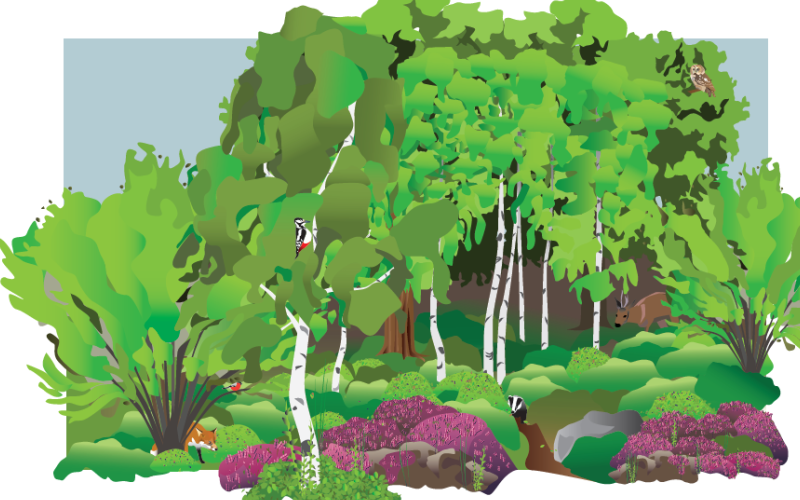
Pioneered in Japan in the 1970’s, the Miyawaki Method of forest creation involves densely planting trees to stimulate rapid growth. Trees are typically planted at 3 per square metre or approximately 600 trees in an area the size of a tennis court. The full Miyawaki Method usually requires significant ground preparation. This involves the turning over of the soil on the site and the introduction of organic matter. The method reduces soil compaction and improves soil structure and nutrient availability. The high density of planting causes competition for light, which can result in rapid tree growth, often in excess of 1 metre per year. Other potential benefits of the method include improvements in biodiversity, carbon sequestration at rates of up to 30 times that of traditional planting schemes, and improved nature connectedness in nearby communities, who are often involved in the planting and monitoring of the sites.
A late arrival in the UK
Although the method was established in Japan over 50 years ago and adopted in countries throughout Asia and India it is a recent arrival to the UK. The first Miyawaki Forest, or Tiny Forest, was planted in March 2020 in Whitney, Oxfordshire by Earthwatch Europe. Since 2020 there have been nearly 300 Tiny Forests planted in the UK. Including around 30 in Scotland, where they are known as Wee Forests. Some sites in North East Scotland have been planted by community groups. These include the Banchory Wee Forest planted by Deeside Climate Action Network, and the Wee Wood planted by Action for Climate and Environment Newburgh. Each site uses variations of the Miyawaki Method. The site at Woodside Primary School in Aberdeen was planted using the full Miyawaki method.
But does it work in North East Scotland?
Organisations such as Earthwatch Europe and the Tree Council have investigated and promoted the method. Including the production of the Miyawaki Handbook and several Tiny Forest Annual Reports. Despite this, scepticism of the method remains, including criticisms that it is expensive and won’t work in the UK. Particularly in Scottish climates. Given that there are a few locations in North East Scotland that have planted using variations of the Miyawaki Method, I took the opportunity to investigate this new methodology for my BSc Honours Project as part of a Wildlife and Conservation Management Degree at SRUC Craibstone
Getting stuck in!
The project aimed to establish the planting densities and to estimate the growth and carbon sequestration rates at the three sites mentioned above. This would help understand whether the growth rate claimed for the method could be achieved in Scotland. With the help of some very generous friends the sites at Newburgh, Banchory and Woodside were surveyed over a series of weekends in September and October 2024. At each site we randomly selected twenty 1m2 plots and counted the number of trees in each one, measured the height of each tree and the diameter of the stem at 10cm and 130cm above the ground. This is no easy task when trees are planted so close together. Especially when it came to surveying plots containing gorse!
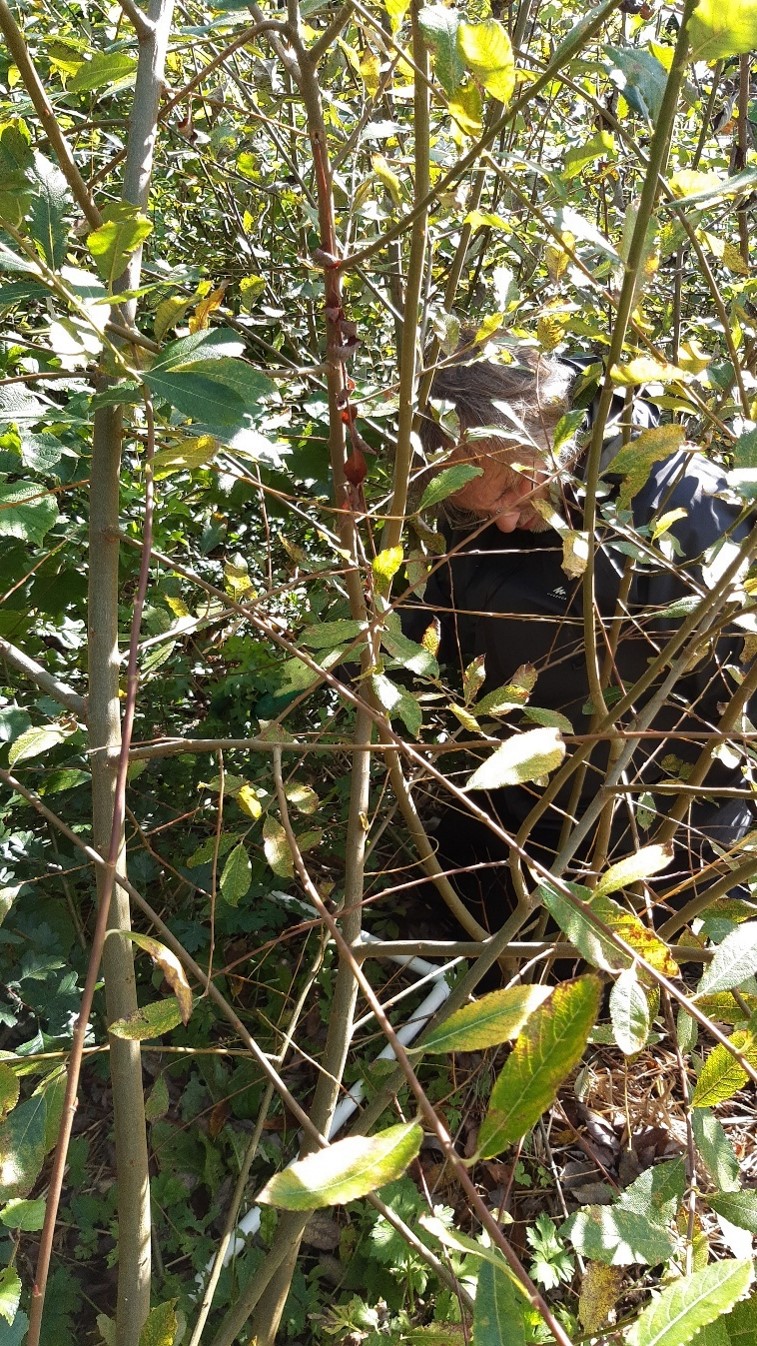
I’m in there somewhere!
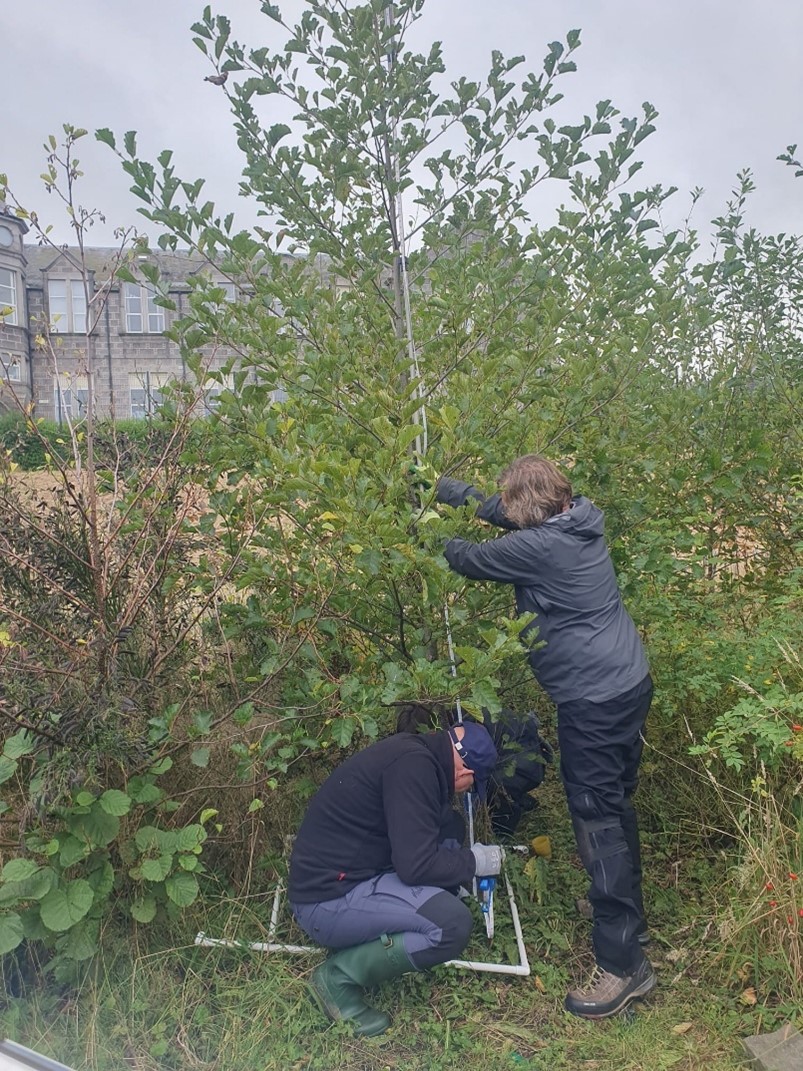
Measuring trees with a washing line prop
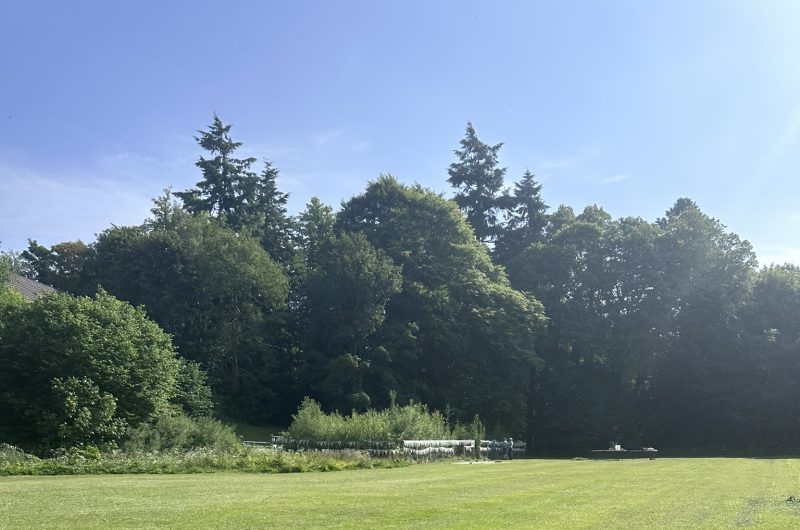
Despite only being planted in 2022 some trees at Woodside were over 4.5m tall! Which required some novel solutions to measuring their height. To measure the tallest trees, a tape measure was attached to an extendable washing line prop. The prop could then be pushed up until it reached the apex of the tree to measure the height. In some cases it was necessary to use two props and tape them together!
Once the surveying was complete, it was time to crunch the numbers using Excel and Minitab (other analysis software are available 😉).
So, what did we find?
Well, it turns out that the method really can produce rapid growth rates.
The plots surveyed at Banchory were planted at an average of 3 trees per square metre. They were estimated to be growing at an average of 1.2m per year! This is despite no ground preparation being done at the site.
The plots surveyed at Woodside were planted at about 2 trees per square metre and growing at about 80cm per year. There was quite a bit of Gorse, Broom and Juniper in the plots surveyed at Woodside. This perhaps explains the reduced average growth rate despite it having the tallest tree, an Alder at over 4.5m. tall!
The site at Newburgh was a little less densely planted (if you can call an average of 1.5 trees per square metre less dense). The trees surveyed were growing at an average of 0.5m per year.
If you compare these numbers to one tree every 2m which is more typical of traditional planting techniques, then you begin to understand just how densely planted these sites are!
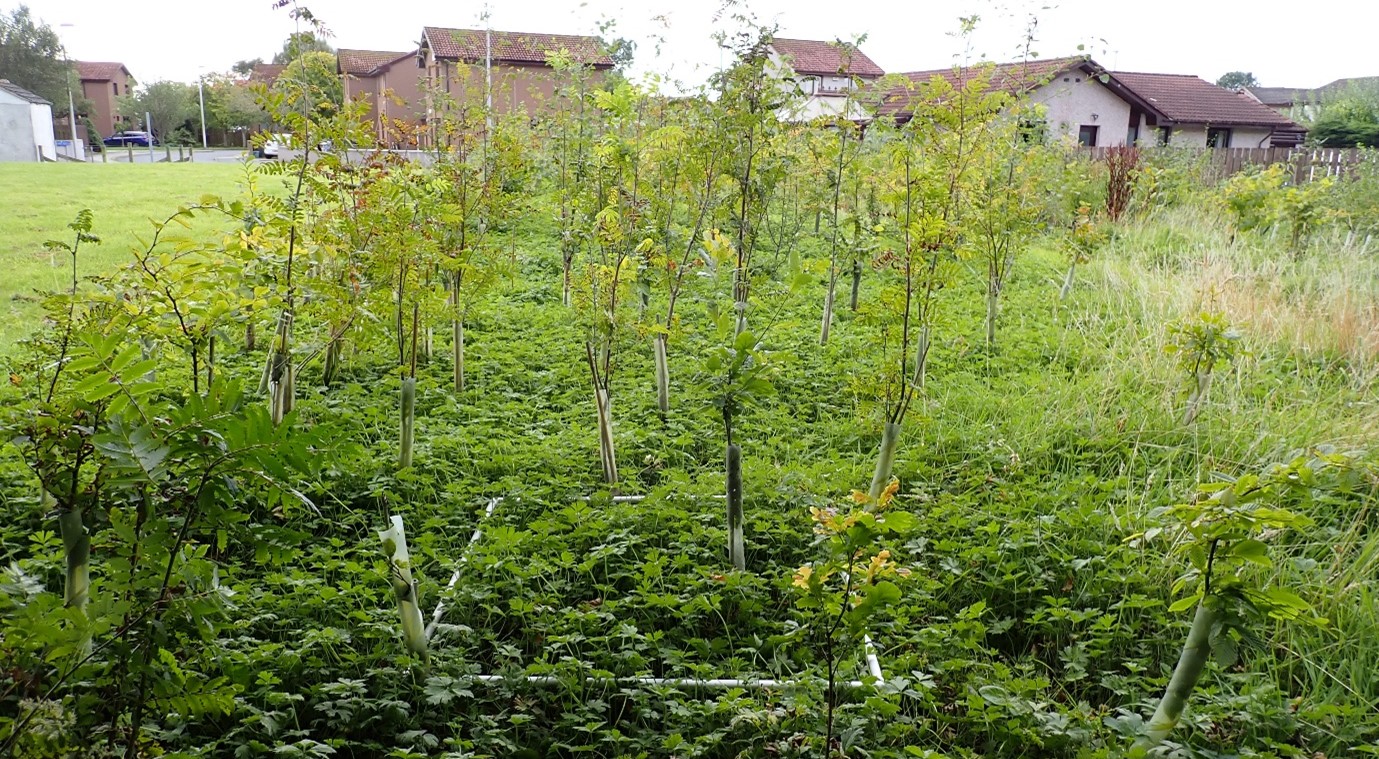
An average of 1.5 trees per square metre is still pretty dense.
Carbon sequestration was calculated using a standard equation (I won’t bore you with the maths). Woodside was storing carbon at the fastest rate of the three sites, at about 0.5kg of carbon per square metre per year. The first site planted in the UK appears to be storing carbon about 3 times faster than Woodside. The site in Oxfordshire has different tree species and a much longer growing season. So it’s probably not an entirely fair comparison. There is also some emerging work that suggests Tiny Forests begin to sequester carbon much quicker once they are between 3 and 4 years old.
So, the evidence suggests that the Miyawaki Method does work, even in Scotland.
This blog has only covered part of the work we did. It only touches on some of the benefits of the Miyawaki Method and completely avoids the limitations of the project. If you would like to find out more about the study, be bored by the maths, or talk anything Miyawaki Method related, then please get in touch at mraby@sruc.ac.uk.
A huge thank you to Dr Helen Anderson and Colin Hardacre for supervising the project. Prof. Kate Pangbourne from ACE Newburgh. Euan and Hillary Duncan of Deeside CAN. Grace Banks and the children at Woodside Primary School. For allowing me to survey their amazing woodland creations. And finally to Ann Miller, Dawn Pirie, James Fox and Jacqui Bell (AKA the Miyawaki Measurers). For the massive amount of help with surveying the sites.

© Abbie Ferrar
More News
Mike Raby
SRUC Student